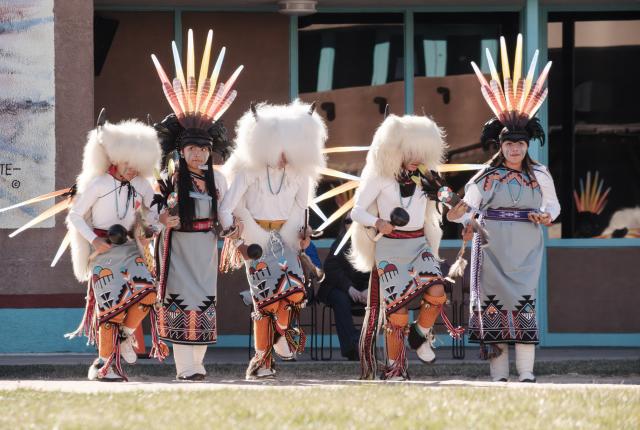
WHEN THE DANCES BEGIN, the thump of the drums is like a heartbeat.
Colorful beadwork flashes against black fabric and white moccasins as Acoma Pueblo’s Sky City Buffalo Ram Dancers toe the dirt in the plaza of the Indian Pueblo Cultural Center (IPCC). Some of the half-dozen dancers are small children, others older, but all move with the same grace to the steady drumbeat, which melds with the rainlike hiss of the dancers’ regalia.
The result is mesmerizing—and intentionally so. As we learn from the Sky City group leader, this social buffalo dance represents prayer and is meant to bring happiness and peace to humankind.
“When people come through the door, they don’t know what to expect,” says Monique Fragua, a member of Jemez Pueblo and the IPCC’s president and CEO. Sharing the sense of wonder that comes from witnessing the dances, the art, and the culture is her favorite part of the job.
“We are a gateway to the pueblos,” she says of the 11-acre campus. Here, in the heart of Albuquerque, visitors can learn history, experience art, engage with Indigenous community members, and quite literally taste, smell, and witness vibrant Pueblo lifeways.
A statue of Pueblo Revolt leader Po’pay at the Indian Pueblo Cultural Center.
Since its founding in 1976, the cultural center has been a convening space for the 19 pueblos of New Mexico who own and manage it and a vital way for the dispersed groups to connect with the public and create economic and social ties with the wider world. Today, the center welcomes thousands of guests annually from all over the world and across the pueblos to dance and watch the performances, to buy and sell art, and to learn and share stories of vibrant and enduring Pueblo cultures.
Over the past half century, the mission and campus have evolved, helping IPCC and its affiliated organizations grow from sharing culture to investing in the economic future of the Pueblo community. To celebrate its 50th anniversary, the cultural center is undergoing a refresh of its interior and exterior spaces and plans to host the Grounded in Clay: The Spirit of Pueblo Pottery traveling exhibition, a 50-year retrospective, and special celebrations and programming throughout the year.
“We are a contemporary center,” says Michelle Lanteri, head curator for the IPCC Museum. “We are grounded in the present, and then our exhibits look both forward and backward.”
The Indian Pueblo Cultural Center is modeled on Chaco Canyon’s Pueblo Bonito great house.
AS YOU MEANDER THROUGH THE CURVED spaces of the IPCC Museum, stone, clay, and fiber objects wait around every turn. But if you pay attention, you can hear their whispered stories.
Among a diverse collection of 30 pots in the main gallery, a glistening black-on-black Santa Clara Pueblo vessel with a simple bear paw symbol pressed into its curve stands out. But upon closer inspection, the artist’s thumbprint is barely visible in the paw, which recalls a time when a bear led the Santa Clara people to water during a drought. For many, the paw also instantly identifies this piece as created by Margaret Tafoya, matriarch of the Santa Clara potters, who originally shaped this blackware piece in 1935.
Eight of Tafoya’s 10 children went on to be potters, passing the tradition on to her grandchildren, great-grandchildren, and great-great-grandchildren. Today, these heirs and the kin of other artists whose work makes up the museum’s 5,000-piece collection are welcomed back to visit—and connect with—their ancestors’ art by telling stories and informing the museum’s exhibitions.
“There are so many details about the art we don’t know,” says Amy Johnson, longtime curator of collections and a member of Isleta Pueblo, reflecting on the ongoing process of contextualizing the museum’s pieces and exhibits. “We’re still learning.”
IPCC Museum head curator Michelle Lanteri.
Central to that process, however, is that these stories are told by Native voices. In the spoken-language portions of the We Are of This Place permanent exhibition, for example, you can hear greetings and phrases from across the pueblos, including some of the only publicly available recordings of the Keres and Towa languages in the world. “It’s our own words, our own language, and our own stories,” Fragua says, “and that makes it really special.”
Throughout IPCC’s programs, staff and volunteers strive to strike a balance between serving as ambassadors and protecting the sacred aspects of Pueblo tradition. Individual guides offer their personal perspective from their Pueblo experience but emphasize that they do not speak for all Native people. Visitors can witness this diversity of experience on display, whether through the rotating installations of modern art or by talking with Pueblo artists who populate the plaza year-round, selling fine jewelry and other handmade goods.
Illuminated by turquoise streetlights and wrapped in murals, IPCC’s adobe building is modeled on the ancient D-shaped Pueblo Bonito great house, which featured more than 600 rooms over multiple stories, in Chaco Canyon. The 76,000-square-foot space, which is now undergoing a restuccoing and renovation project, houses the museum, galleries, gift shop, and Indian Pueblo Kitchen restaurant. It also serves as the home to the archival library that holds the records from the former Albuquerque Indian School, which occupied the property across the street from the center from 1881 to 1982.
IPCC president and CEO Monique Fragua.
After the school closed, the land was placed in a federal trust, and the governors of New Mexico’s pueblos designated it for economic development. Although the brutal history of Indian boarding schools in North America is a painful one, in which children were taken from their homes and their culture stripped from them, the story of the Albuquerque Indian School is complicated. To be an Albuquerque Brave “meant something to a lot of people,” Fragua says. “People were proud of it.”
This has made the site even more meaningful for so many Pueblo people and helped to inform the IPCC vision as an educational hub, where community members come together, connect, and engage with people and opportunities beyond the pueblos. In fact, visitors can sit at an old boarding-school desk, admire a letterman’s sweater, and learn about the students who once learned in this place.
“But the museum is just a small part of what we do,” says Fragua, who previously served as the museum director before taking over as the first female president and CEO of IPCC, and the affiliated for-profit Indian Pueblos Marketing, in April last year.
Kennedy Cooper and Olivia Russell prep for the Kids Cook program at the Entrepreneur Complex.
THE SCENT OF FRESH-BAKED PUEBLO PIES IS in the air at the Indian Pueblo Kitchen. The on-site restaurant, with soaring vigas and a massive stone fireplace, launched back in 1976 and today remains a popular destination for Indigenous cuisine.
Crafted by head chef Josh Aragon, of Laguna Pueblo, the menu includes both the familiar—such as atole, Indian tacos, and blue corn enchiladas—and the unexpected, like fried Kool-Aid pickles.
“They’re marinated in black cherry Kool-Aid, then battered in blue corn,” explains Aragon, who started as the restaurant’s dishwasher back in 2018. The result is a purplish, tangy, crunchy treat that pairs perfectly with the accompanying green chile ranch sauce. Fragua recalls a time growing up on Jemez Pueblo when putting Kool-Aid on just about everything was in vogue—and that nostalgia helps make the playful appetizer one of her favorites.
Aragon can often be found strolling the dining room, listening to guests. “I used to hear my grandma say if you cook with bad thoughts or negativity, you’ll make people sick. We live by that,” Aragon says. “There’s a lot of laughter, joking, and passion for the food in the kitchen here.”
For his part, Aragon wants to utilize even more fresh produce from the on-campus Resilience Garden, which currently grows Southwestern staples like heirloom corn, beans, and cilantro, and create a more seasonal menu that reflects the traditional ingredients and cooking methods of the pueblos throughout the year.
from left
Indian Pueblo Kitchen fare. Order a frybread taco at the Indian Pueblo Kitchen.
Like Aragon’s vision for the expanded Resilience Garden, IPCC continues to nurture economic opportunities on its campus and beyond. In 2015, the Pueblo-owned Avanyu Plaza shopping center opened on the land where the main Albuquerque Indian School building once stood. The 47,300 square feet of retail space is home to a dozen businesses (and counting), including the Pueblo-vegan spot Itality, the first Native-owned Starbucks in the country, the 12th Street Tavern, and the Rainwater Wellness day spa.
But having a place for Pueblo businesses to set up shop is only half the equation. To better support entrepreneurship, IPCC launched the Indian Pueblo Entrepreneur Complex in 2024. The space provides technical support and equipment, commercial kitchen space, and other tools for up-and-coming food entrepreneurs. The goal, according to Fragua, is to create “a place an entrepreneur could come, start their business, and grow into a retail space nearby.”
LaShon Cate, owner of Just Peachy Pueblo Biscochitos and a member of San Felipe Pueblo, is one of 30 entrepreneurs it has helped since opening. “It’s an amazing space for small business owners, chefs, and cooks to share,” she says.
from left
Josh Aragon leads the Indian Pueblo Kitchen. Just Peachy Pueblo Biscochitos owner LaShon Cate.
In addition, the team’s support has been pivotal in helping Cate navigate labeling challenges and other regulatory issues that have held the company back in recent years. “The team there is very, very resourceful,” she says. “They’ve been instrumental to our growth.”
While it may seem small on the surface, these personal victories can have a big impact on Pueblo families and communities. That includes the cultural center’s Daily Artist program, which allows Pueblo artisans the chance to sell their art and interact with customers in the courtyard year-round. Similarly, the Indian Pueblo Shop inside the main building provides a location for more distant artisans to sell their work—from jewelry and hand-carved flutes to tea and locally-grown Indigenous ingredients—even when they can’t be present in person.
“Buying Native jewelry has a generational impact,” Fragua says, because these crafts are often passed down at the kitchen table. In that way, shopping at the Indian Pueblo Store, dining at the Indian Pueblo Kitchen, and learning about Pueblo traditions not only helps preserve culture, it helps to ensure a vibrant Pueblo present and future.
“In New Mexico, we have the opportunity to engage with Pueblo culture all the time,” Fragua says. She’s hopeful that IPCC’s work will encourage people to invest in Pueblo art, work with Pueblo businesses, and accept invitations to Pueblo feast days.
As IPCC looks ahead to the next 50 years, Fragua envisions developing the campus for even more of this cultural sharing and long-term impact, with goals to build an on-site theater, host an Indigenous film festival, and launch more hands-on learning opportunities for children.
“We want our guests to always take a little something with them, whether that’s pastries, dance, language,” Fragua says. “That’s the experience we want to create.”
Freelance writer Sarah Mock enjoyed IPCC’s annual Pueblo Gingerbread House Contest, held every year in December.
NIFTY AT 50
Grounded in Clay: The Spirit of Pueblo Pottery, an Indigenous art and culture exhibition that has been touring the U.S. for the last five years, will be on display at the museum from March 20 to February 21, 2027. Look out for 50 for 50: Indian Pueblo Cultural Center 1976–2026 in the Artists Circle Gallery at the same time, which highlights the history of IPCC through Pueblo community perspectives of the past, present, and future. Special 50th anniversary IPCC products and programming are planned throughout 2026.
CENTER OF EXCELLENCE
Spend a day or a weekend at the Indian Pueblo Cultural Center campus.
Eat. Start your culinary journey at the Indian Pueblo Kitchen for an Indian taco with ground lamb and a Famous Pueblo Pie. Pop across the street to grab a latte at the only Indigenous-owned Starbucks in the U.S., or journey a little further into the Avanyu Plaza to find Itality, a Pueblo-vegan spot with killer smoothies and blue-corn-pepita-meal waffles. You can also get your fix of brews, Bavarian pretzels, and Popsicle lemonades at the Pueblo-owned 12th Street Tavern, or sip a cocktail and crunch on some shareables over at Sixty-Six Acres. If you need a quick bite, Laguna Burger serves an impressive green chile cheeseburger alongside its signature shakes. On the go? Look for the new Indian Pueblo Kitchen outpost at the Albuquerque International Sunport.
Stay. When you just can’t fit all the Pueblo cultural experiences into one day, grab some shut-eye at the Pueblo-owned Holiday Inn Express in the Avanyu Plaza or the TownePlace Suites by Marriott, if you’re looking for a homier experience or have a pet in tow. To stay in a room decorated by a contemporary Pueblo artist, book a night at Nativo Lodge, just off I-25.
Shop. Stop into the Indian Pueblo Store gift shop to both learn about the artisans and pick up some turquoise, silver, or fine fiber arts to take home. Plus, Avanyu Plaza is home to New Mexico’s largest rock and bead store, Mama’s Minerals, and the forthcoming La Montañita Food Co-op.
Do. Even if you’re just driving by, swing through the roundabout at 12th Street and Menaul Boulevard to see the epic Pueblo Matriarch sculpture by artist Greyshoes, who called this 20-foot-tall piece “the mother of the Cultural Center.” At the end of the day, let it all sink in with a relaxing massage at the Native-owned Rainwater Wellness day spa.