FROM NM 53 IN THE HEART OF ZUNI PUEBLO, you can’t miss it: a gleaming metal building rising from red earth. Out front, an angular solar carport tilts toward the sun, casting a long geometric shadow. When pulling into the parking lot at Major Market, the only sounds you hear are the gentle hum of electric vehicle chargers and the crunch of gravel under tires. The bright store is unexpectedly sleek for such a remote corner of western New Mexico. But inside, you’re greeted by the homey aroma of fresh-brewed coffee, rows of vibrant local produce, shelves stocked with pantry staples and Zuni-made goods, and the warmth of a locally owned business rooted in generations of care.
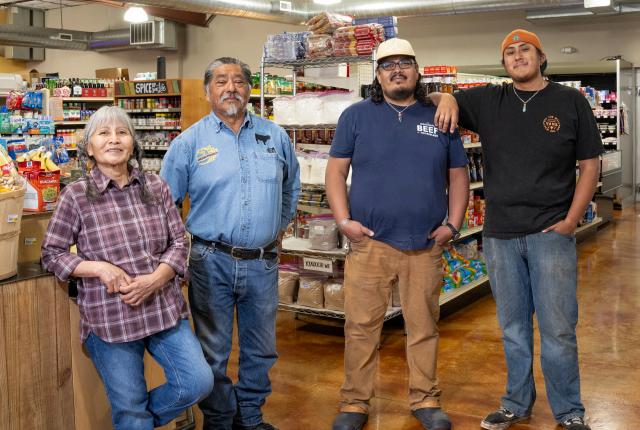
“There really aren’t that many 100-percent Zuni-owned businesses in town,” says general manager David Tsabetsaye, whose family opened the market in 2020. “Most everything else—gas stations, jewelry shops—are owned by outside families or corporations.”
Colin Tsabetsaye at the Eat & Go restaurant.
The Tsabetsaye grocery dynasty spans three generations. David’s grandfather Robert Tsabetsaye once ran five stores across the pueblo. After those shops faded, his parents, Darrell and Roscelia, established the first Major Market as a convenience store in 1988, but were forced to sell it in the early 2000s. By the late 2010s, it was time for a new chapter. After two decades as a chef in Albuquerque, David returned to help his family build this incarnation from the ground up. They opened during the height of the pandemic with an ambitious mission: bring fresh groceries and healthy meals to the pueblo, support local and organic producers, and serve as a community hub.
“It’s hard for us to get stuff out here,” Tsabetsaye says, noting that the store tries to match or beat the prices of Gallup’s Walmart, about 40 minutes away. “But with better quality.”
Amid the more conventional items in the aisles, you’ll find shelves of goods essential to the pueblo’s mostly Indigenous population of about 12,000: Blue Bird Flour, dried red chile, roasted green chile, Zuni Gold beans, Zuni-made sourdough loaves and he’balokya (sweet cakes) from Sunny Days Bakery, and house-processed blue and red corn. “We roast and grind our own corn—tons of it,” Tsabetsaye says. “We want to keep it as local as possible.”
The Zuni store offers hard-to-find groceries.
Major Market’s house-smoked deli meats, rotisserie chickens, and the USDA-trained butchers have been one of the biggest draws. “It’s been quality since day one,” Tsabetsaye says. A dehydrator and smoker sit outside, along with backup generators to keep things running in case of outages. “Everything’s prepared with human hands,” he says.
At the west side of the store, the Eat & Go restaurant’s spotless open kitchen prepares an eclectic menu of house-made salads, sandwiches, and pastas rarely seen in grocery store settings—roasted butternut squash and wild rice salad, almond-crusted baked brie en croûte, pressed cubanos, and ragù alla bolognese with pancetta and mornay sauce—as well as specials like lengua quesadillas and chilaquiles rojas. One recent standout pairs crisp-edged brussels sprouts with slices of juicy brisket, the charred greens catching just enough rendered fat from the meat to turn luscious, smoky, and deeply flavorful.
“Hey Dave,” a UPS delivery driver yells from the doorway, “that burger was bomb the other day!”
Tsabetsaye’s culinary journey began by watching his grandmothers and mother in the kitchen, then helping his uncle, a butcher, in the small deli at the original Major Market. After graduating from the culinary arts program at Albuquerque’s Technical Vocational Institute (now CNM), he spent nearly two decades in fine dining. He credits his time as sous chef for Zinc Wine Bar & Bistro and Seasons Rotisserie & Grill, both in Albuquerque, for teaching him what sells and how to adapt recipes to community demand.
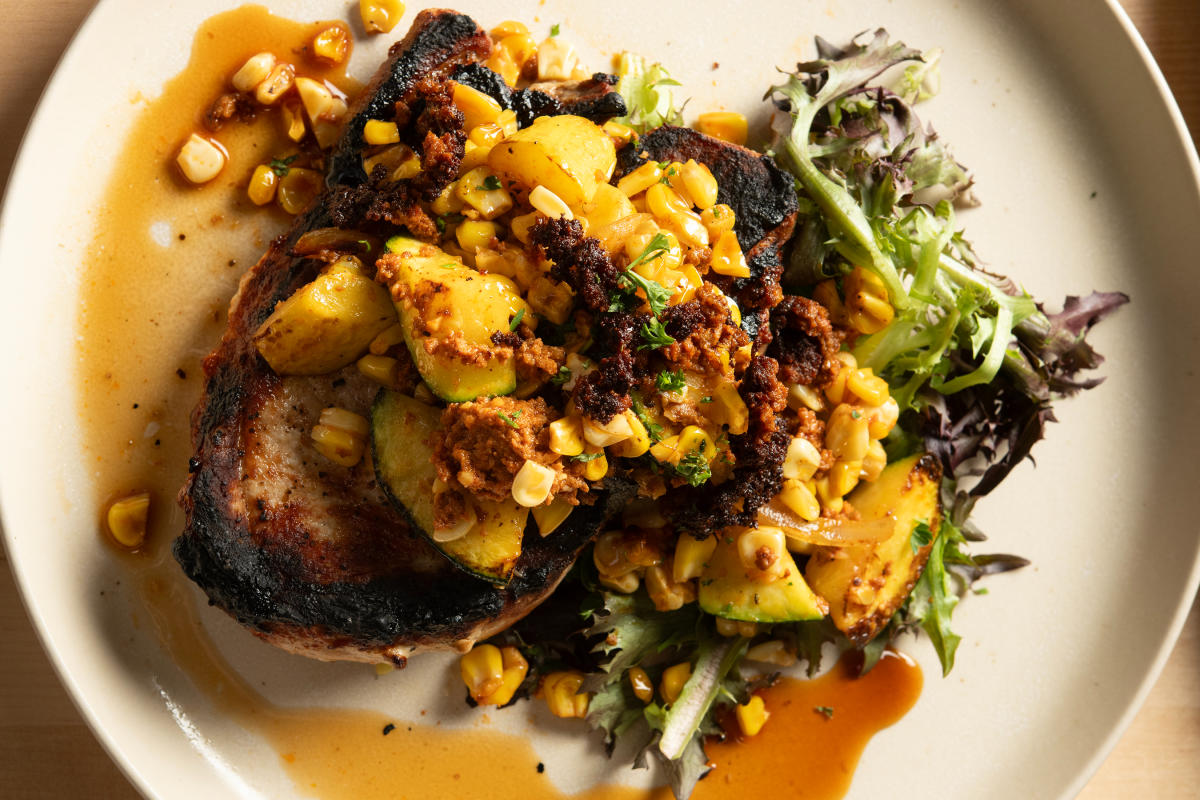
Pork chops with chorizo calabacitas.
“I hadn’t lived in Zuni for over 20 years,” he says. “I didn’t know what people would buy.” He landed on a mix of dishes that are hard to find on the pueblo, as well as classic New Mexican and Indigenous fare like green chile stew and red-chile-braised pork over blue corn waffles with calabacitas.
Still, Tsabetsaye is careful about where his menu overlaps with local food sellers. “A lot of people in Zuni sell food out of their houses—tamales, enchiladas. I don’t want to steal their sales,” he says. The market also steps up during cultural events, like Shalako, the annual winter solstice ceremony that brings family and visitors back to the pueblo. “We’ll put together more traditional specials for them, like our stews or pork chops,” he says, “which are pretty damn good.”
Beyond groceries and prepared foods, Major Market serves as a community resource. Near the entrance sits the pueblo’s only Amazon Locker. To the side is a designated Starbucks coffee counter. In the back, a water-filtration station provides reverse-osmosis drinking water and ice—critical in Zuni, where hard water and arsenic levels are a concern. The market runs largely on solar power and boasts one of the pueblo’s first fiber internet connections, with a server rigged to help neighbors get online.
That community-minded ethos extends to education. The family founded the nonprofit Hawikku, supporting Zuni (A:shiwi) people through culturally grounded programs in science, agriculture, business development, stewardship, and more. They work closely with the Zuni Youth Enrichment Project (ZYEP), teaching food sovereignty classes that range from how to make brisket tacos to gardening and rainwater catchment systems.
“Smoking is a traditional means of food preservation,” Tsabetsaye says. “We show the kids how to smoke meat, grind corn, make tortillas from scratch. Last year, we did salmon, elk, and pizza with vegetables from the garden. It’s about passing on skills.”
Such generational continuity is woven into the business’ DNA. Tsabetsaye’s parents open the store every morning, seven days a week. His brother Shaun, an electrical engineer with an MBA, oversees the building’s IT and renewable-energy systems. Cousins Gordon and Josh help in the kitchen, and Tsabetsaye’s son, Colin, cooks alongside him. “Working with family is hard, no matter how you slice it,” Tsabetsaye admits with a laugh. “But when the going gets tough, they’re there. We have to remind ourselves: We’re doing things Zuni hasn’t seen before. There’s a learning curve. But the end product is worth it.”
For the market’s other dozen employees, Tsabetsaye says the work is a passion, not just a job. “They see something in us,” he adds. “They want to be part of it.”
Similarly, Tsabetsaye says coming home to Zuni wasn’t just a business opportunity. It was about restoring his family legacy and shaping the future of the pueblo. “My grandpa was once the richest man in Zuni,” he says. “He lost it, but I think that’s where our entrepreneurship came from. It’s nice to have something of your own—especially when it’s for your own people.”
Senior Editor Candolin Cook recommends taking the Halona: Idiwan’a (Middle Village) tour while in Zuni.
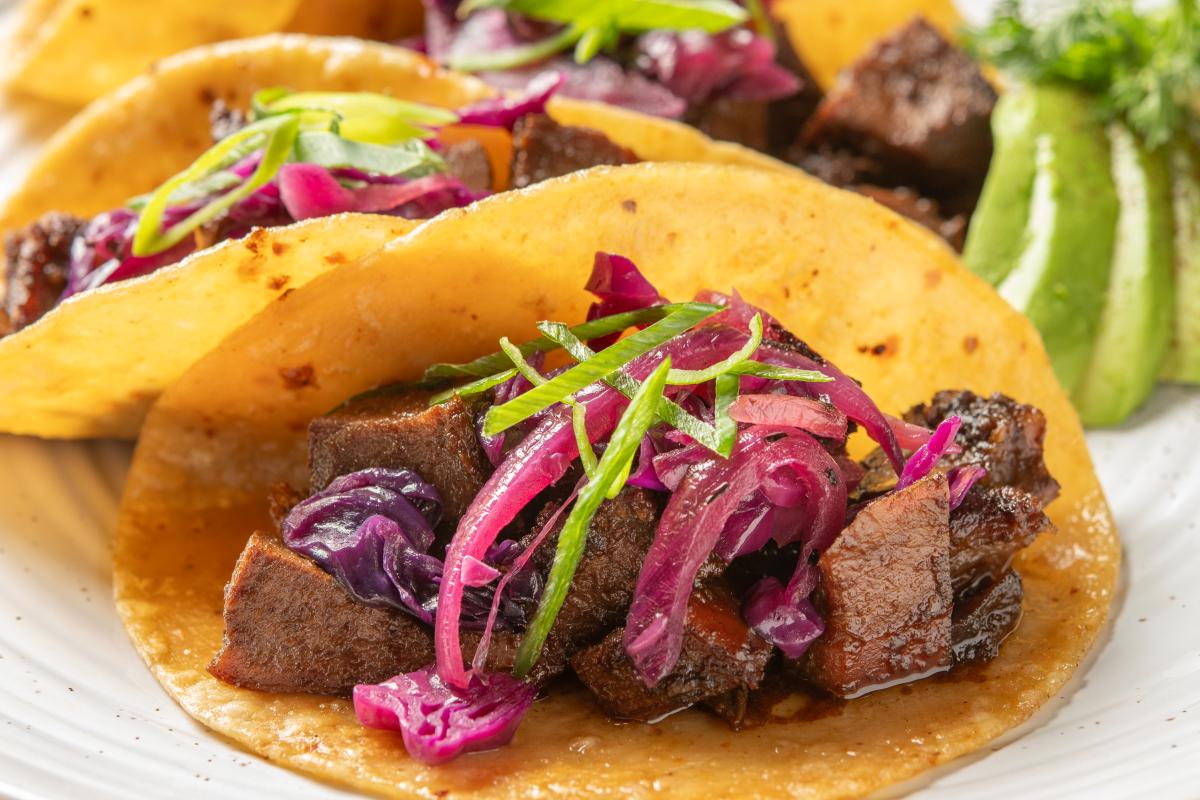
“This simple yet delicious protein may be intimidating in more ways than one,” says Major Market general manager and chef David Tsabetsaye. “But rest assured, this is one of the most underrated, beefiest cuts of meat on a bovine.” With patience and a slow cook, lengua (beef tongue) transforms into a tender, flavorful dish that works beautifully on its own or in tacos, quesadillas, and sandwiches. “It is well worth the wait,” promises Tsabetsaye.
- 1 large beef tongue (about 3 pounds)
- ¼ cup beef tallow or 8 ounces beef trim with fat, cut into small pieces
- 1 large onion, halved
- 3 Roma tomatoes
- 6 garlic cloves, smashed
- 4 whole dried New Mexico red chiles, seeds removed
- 1 tablespoon ground cumin
- 2 tablespoons ground coriander
- 2 tablespoons dried oregano
- 4 bay leaves
- ½ tablespoon whole black peppercorns
- 1 gallon beef stock or water
- 2 tablespoons salt or to taste
- 3 chipotle peppers in adobo sauce
- Vegetable oil
Serves 6 to 8 as main dish
1. Thoroughly rinse beef tongue under cold water. Cut into 3 pieces equal in size, set aside.
2. In a large heavy-bottomed pot over medium heat, melt tallow. (If using beef trim, brown it first to render as much fat as possible without burning.) Add the onion halves, cut side down, tomatoes, and garlic. Reduce heat to medium-low and cook until vegetables are lightly charred, turning occasionally. If smoking occurs, reduce heat.
3. Meanwhile, preheat the oven broiler. Place red chile pods, cumin, coriander, oregano, bay leaves, and peppercorns in an oven-safe pan. Toast on the lowest rack until fragrant, about 1–2 minutes, then remove from oven.
4. Add tongue to the pot with the charred vegetables. Dust the toasted chiles and spices over top. Pour in the beef stock or water, ensuring the tongue is fully submerged. Stir in the salt and chipotle peppers.
5. Bring to a boil over high heat, then reduce to medium-low. Cover and simmer, checking occasionally to make sure the tongue remains submerged. After about 2 hours, remove the fattest piece and cut a lengthwise slit into the thick outer skin. If skin peels easily, remove all pieces from pot and peel. If not, continue cooking until it does. Discard skin. Return peeled tongue to pot, cover, and cook on low for another 3 hours, or until very tender.
6. Remove tongue and let rest until cool enough to handle. Slice or chop to preferred size.
7. Strain the braising liquid into smaller pot, discarding the aromatics. Simmer over medium-high heat until reduced by half.
8. Heat an oiled sauté pan on medium-high. Sear the sliced lengua until browned, set aside. Deglaze the pan with the reduced braising liquid, allowing it to thicken into a sauce.
9. Serve lengua and sauce in soft corn tortillas for tacos, over creamy mashed potatoes, or piled on crusty bread for a rich sandwich.
David Tsabetsaye says these “damn good” pork chops were one of the first meals he made in culinary school. The dish remains a go-to: “It’s super simple, can be executed quickly, and packs a punch in the flavor department.”
- 4 to 6 thick-cut boneless pork loin chops (¾–1 inch)
- Salt and pepper, to taste
- 3 tablespoons oil, divided
- 1 large yellow onion, sliced
- 2 ears sweet corn, shucked (roasted if desired)
- 1 large Mexican squash, cut on the bias
- 1 large yellow squash, cut on the bias
- 1 large zucchini, cut on the bias
- 3 garlic cloves, peeled and minced
- ¼ pound chorizo (or 3 links, casing removed)
- Fresh cilantro, chopped, for garnish
Serves 4 to 6
1. Preheat oven to 350°. Heat a large, heavy oven-safe skillet over medium-high heat.
2. Season pork chops generously with salt and pepper. Add a drizzle of oil to the pan; when it shimmers (but before smoking), carefully place chops in the pan without overcrowding. Sear for about 2 minutes per side, until browned and slightly charred at the edges.
3. Transfer pan to the oven and roast about 6–10 minutes, until the internal temperature reaches 145°. Remove from oven, tent with foil, and let rest. Reserve any juices.
4. Discard excess grease from pan. Return skillet to medium heat, add a fresh drizzle of oil, and sauté onion until softened and lightly golden. Add corn, squash, garlic, salt, and pepper. Increase heat to medium-high and cook until vegetables are tender.
5. Push vegetables to one side of pan. Add chorizo to the cleared side, breaking it apart as it cooks. Once browned, stir chorizo into the squash mixture. Pour in reserved pork juices and toss to combine.
6. Serve pork chops topped with the chorizo-calabacitas mixture. Garnish with cilantro.