INSIDE MEOW WOLF’s House of Eternal Return, the lobby goes dark, swallowing the doorway behind you. As your eyes adjust, a glowing two-story house appears with every window lit. To the right sits a mailbox, holding three letters: two sympathy cards addressed to members of the Selig family, the house’s original owners, and one welcoming you as Agent Thirty-Five, custodian of a containment zone. The Seligs, it turns out, broke time and space—and the Victorian house is what remains, still humming with what they left behind. Your job is to solve the mystery of what happened to the family and where they’ve gone.
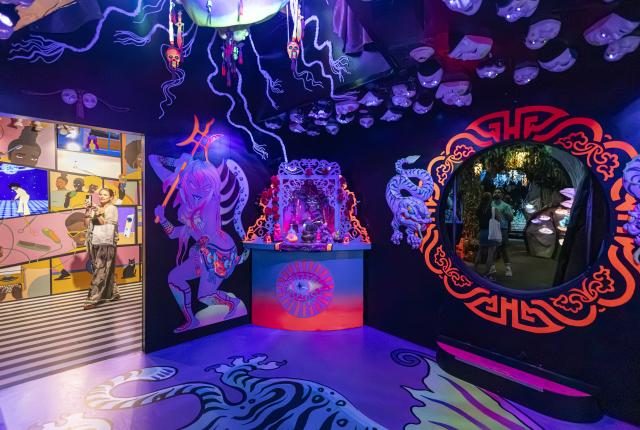
Nobody hands you a map or tells you to keep your hands to yourself. This isn’t a museum where the art hides behind velvet rope: Since its debut in 2016, House of Eternal Return has always wanted you to touch everything. Open the refrigerator to discover a portal. Crawl into the fireplace and surface inside a glowing ice cave, where a mastodon’s rib bones double as a musical instrument. Wiggle into the washing machine, and a slide dumps you into a world of socks.
Step through a portal to a way more artistic realm at Meow Wolf’s "House of the Eternal Return."
Photograph courtesy of Meow Wolf.
“It’s storytelling that you can be a part of,” says Meow Wolf co-founder Vince Kadlubek. It’s like a video game where you’re a real-life character. “The rest of the art world says if it’s story and entertainment, then it’s not art,” he says. “We’re like, nah.”
Ask Kadlubek if Meow Wolf could have happened anywhere outside Santa Fe, and his answer is immediate. “This is a true birth from the soil of this place,” he says of the city’s history of welcoming this kind of fringe-thinking artistic community. “We knew that burners and weird art kids would come and flock and love it,” he explains.
In 2008, Kadlubek spotted the shuttered storefront for In Your Dreams hair salon while eating a breakfast burrito across the street. A thousand dollars a month rent, split 10 ways, seemed doable for the crew of broke but creative young people who had been holding temporary exhibitions around town.
That night, they pulled words from two hats and landed on a name: Meow Wolf. Their first show opened two weeks later, on Valentine’s Day, after two artists spent that stretch turning wall murals into an entire immersive world. They delivered food for years to stay afloat, chasing the vision with cardboard-box donations, until A Song of Ice and Fire author George R.R. Martin bought them a shuttered bowling alley.
With between 70 and 85 distinct spaces (including possibly the weirdest space to see live music in New Mexico), built by a rotating roster of local and international artists, no two visits to Meow Wolf Santa Fe are alike. Australian-based art collective Pip and Pop, for example, devised a candied landscape of sugary skies and glittering, pink hills. The Trash Temple pays homage to our consumption culture with a floor-to-ceiling shrine built from bottle caps, CDs, and old Elmo dolls. Roughly 30 plush hamsters are hidden throughout it all. “You can go deep if you want—or it’s totally enjoyable if you don’t even think about solving the mystery,” says Kate Daley, director of marketing and sales at Meow Wolf Santa Fe.
The mastodon's rib bones double as a musical instrument.
Photograph courtesy of Meow Wolf.
In a world disconnected from time and space, Cochiti Pueblo artist Virgil Ortiz’s vision feels right at home. Overseen by a massive glowing head, his futuristic laboratory transports the story of Po’pay and the Pueblo Revolt of 1680 in a futuristic setting of 2180. “Each element tells a piece of the story,” he says. “It’s a reminder of perseverance, hope, and the belief that every journey forward begins with curiosity.”
Kadlubek sees Meow Wolf’s scrappy start as part of a greater lineage. “There’s a lot of creators—George Lucas, Dr. Seuss, Jim Henson—who did a little bit of a Trojan horse thing, welcoming people into another world beyond their knowing,” he says. “They packaged it accessibly. That’s the lineage Meow Wolf comes from.”
The gamble paid off: The team hoped for 125,000 visitors that first year in the former bowling alley and got 400,000. That creative wellspring now includes Meow Wolf outposts in Houston; Grapevine, Texas; Denver; and Las Vegas, Nevada, with plans for openings in Los Angeles and New York City.
“The love that New Mexico has shown has been the fuel that has propelled this success,” Kadlubek says. Ten years in, the Seligs are still missing, the hamsters are still hiding, and the state’s creativity is still manifesting.
Read more: Reports of green fireballs have followed New Mexico since the 1940s. One winter-night sighting brings the mystery close to home.