


A SETTING SUN casts a golden glow over Albuquerque’s Old Town Plaza as hometown trio Felix y Los Gatos takes the historic gazebo stage. Frontman Felix “Gato” Peralta thanks the sizable audience seated on camp chairs and blankets for coming to Old Town’s first concert of the summer. Then he launches into the group’s crowd-pleasing ranchera bop, “Nuevo México.”
“Take me back to Nuevo México,” sings Peralta, as couples leap up, twirling and circumnavigating the stage in steps of one and two. “Up to Chama to Chi-may-ó, I can see my family, down in Chi-li-li, take me back to Nuevo México.” The Latin rhythm shuffles and snaps, driven by Arnaldo Acosta’s crisp percussion and Justin Bransford’s rolling bass. Peralta’s reedy button accordion and nimble guitar lace the groove together, crafting a sound that feels like a love letter to the land and the people who shaped it.
The South Valley native says much of his songwriting comes from New Mexico’s beauty and “the eclectic gumbo of 19th-century vaquero tales from the Southwest.” He’s part of a storied and diverse musical lineage. “Music allows us to participate in a shared identity,” says Jordan Wax, co-founder of the northern New Mexico string band Lone Piñon. For centuries, he says, the region has hummed with sounds forged by Indigenous, Spanish, Mexican, Anglo, and other influences. In the same village, you might hear indita ballads, 18th-century alabados, and polkas, all introduced by settlers but transformed into something distinctly New Mexican. Played on violins, accordions, and guitars, these tunes provided the pulse for weddings, fiestas, and fandangos.
After World War II, many regional styles began to fade, eroded by urbanization, migration, and the new popularity of electrified rock, soul, and ranchera beats. Since forming in 2014, Lone Piñon has worked with elders to help revive prewar repertoires as a living tradition. “We find ways to make it resonate personally,” Wax says, “and in this moment.

The Black Pumas play a Lensic 360 show at HIPICO Santa Fe. Photograph by Amanda Powell/Courtesy of Lensic 360.
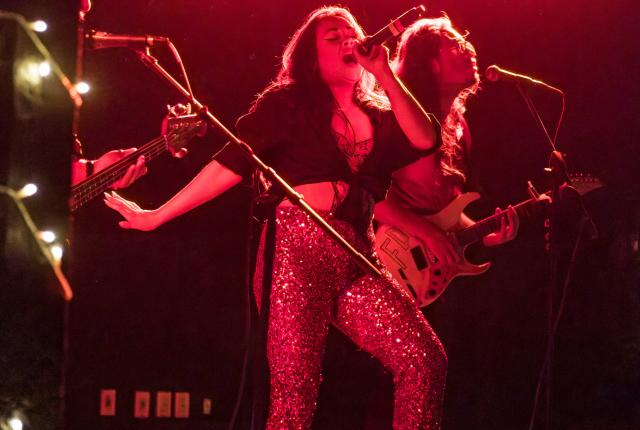
IN THIS MOMENT, NEW MEXICO’S MUSIC scene might be resonating like never before. Artists such as Lara Manzanares and Mozzy Dee carry the spirit of traditional storytelling forward, while acts like Diné rapper Def-i and the Latin-fusion group Baracutanga bend genres. At the same time, a growing number of national musicians are finding inspiration—and new fans—in the Land of Enchantment.
“Musicians love to play New Mexico. I think that’s a testament to our creative community,” says Jamie Lenfestey, the director of Lensic 360, which brings concerts to venues throughout the northern part of the state. “There are more opportunities than ever to hear people play,” he adds, crediting population growth and fresh partnerships among promoters, venues, and artists.
That appreciation echoes across the state—whether in Tijeras, where Third Eye Studio turns out nationally recognized recordings, or in Las Cruces, at the mom-and-pop vinyl shop Eyeconik Records & Apparel. Festivals like Ghost Ranch’s scenic Blossoms & Bones and Taos’s Americana-fueled Big Barn Dance fill summer calendars, while an expanding roster of unique venues—from the neon glow of Meow Wolf’s avant-garde concert hall to the honky-tonk dance floor of Ruidoso’s Win Place & Show—are lining up shows.
Grassroots efforts foster inclusivity. Indigenous musicians are joining forces to amplify their voices, while good old community radio keeps the airwaves humming with norteño, punk, country, and more. In a place where so many traditions converge, music remains a vital form of collective expression.
“The power of music is that it’s a very physical experience that the performers and listeners or dancers share,” Wax says. “With New Mexico’s history, that can create an opportunity for healing—and reconnection.”
LISTEN UP
Hear the featured artists in this issue—and many more—on the New Mexico Magazine Music of Enchantment playlist: nmmag.us/music-of-enchantment.
READ MORE
Deep in the Navajo Nation, a family band called Testify blends thrash riffs with Diné culture.