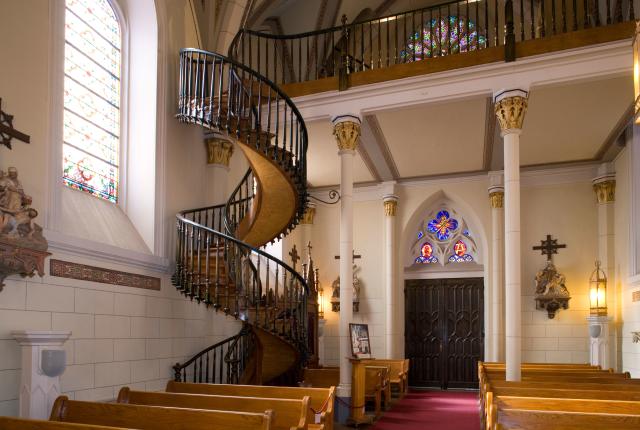
WHO BUILT THE LORETTO CHAPEL STAIRCASE?
Catholics are no strangers to mysteries of faith, but the Loretto Chapel staircase takes that divine whodunit to another level. Built in the late 1800s, the wooden spiral to the choir loft is miraculous not only because no nails or glue were used in its construction, but also because it has no visible central support structure. “Not a single engineer has been able to tell us the weight-bearing capacity of our staircase,” says curator Richard Lindsley. Given the advanced design and the wood used—which is also of unknown origin—the mystery remains who built the staircase. The chapel’s nuns believe it was St. Joseph himself, the patron saint of carpenters to whom they prayed for help, though amateur historian Mary Jean Cook argues it was probably local rancher and expert woodworker Francois-Jean “Frenchy” Rochas. Go and see: Deconsecrated in 1971, Loretto Chapel operates as a private museum, just off the Santa Fe Plaza, where you can witness the miraculous staircase and learn more about its history
Bikers test the Alien Run Trails in Aztec.
Photograph by Jen Judge.
WHAT CRASHED IN AZTEC?
In March 1948, a rancher near Aztec heard a boom and looked up to see a flying saucer headed toward nearby Hart Canyon. But the details get murkier from there. According to homegrown UFOlogist Suzanne Ramsey, the government removed a large UFO from the crash site, potentially with alien occupants still inside. Whether you’re a believer, investigator, or just a curious adventurer, the site and its historic marker—about 4 miles into the Alien Run Trail System—are worth a visit. “The views are spectacular,” Ramsey says. Go and see: With three stacked loops, the Alien Run Trail System is a favorite among mountain bikers for its swooping flows, slickrock areas, and adrenaline-fueled single track.
The Tiffany Turquoise Mine, in Los Cerrillos, was named for the jewelry company.
Photograph courtesy of Palace of the Governors Photo Archives, New Mexico History Museum (005237).
WHERE DID NEW MEXICO’S TURQUOISE MINES GO?
The intricate spiderweb patterns found in fine turquoise are not only a mark of the stone’s quality, but also of its mysterious origins. High-quality turquoise is exceedingly rare, yet some of the most beautiful gemstones have come from New Mexico, including the Tiffany Turquoise Mine near Cerrillos. Today, however, these veins have been exhausted, leaving almost no turquoise operations in the Land of Enchantment. “Many locations lack one or more of the factors needed to form turquoise,” says Jacob Lowry, executive director of the Turquoise Museum in Albuquerque. “These rarities are what make turquoise one of the most collectible and intriguing gemstones in the world.” Go and see: Located in Albuquerque’s Gertrude Zachary Castle, the Turquoise Museum has one of the finest collections in the world, including many gems from now-defunct New Mexican mines.
➤ Nearly 130 years ago, the disappearance of this father and son opened an unsolved case that continues to resonate.