


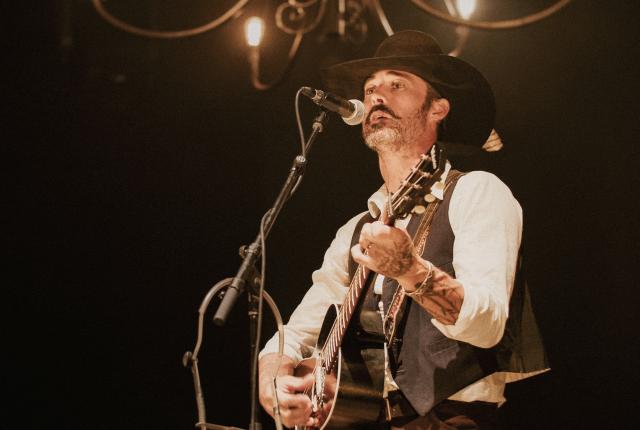
RYAN BINGHAM’S MUSIC has never strayed far from the landscapes that shaped him. Born in Hobbs to a ranching family with deep roots in southeastern New Mexico, the singer-songwriter grew up across the greater Southwest, rodeoing and eventually playing the bars and honky-tonks that became his first stages. His weathered voice and songs about hard-luck characters and wide-open country broke through nationally with his 2007 major-label debut, Mescalito. The next year, Bingham returned to New Mexico to appear in the film Crazy Heart (2009) and co-write its theme, “The Weary Kind,” which earned him an Oscar, a Golden Globe, and a Grammy.
Now, after several more albums, films, and a recurring role in the series Yellowstone, Bingham is back with They Call Us the Lucky Ones, his first full-length album in more than seven years. Recorded largely live with the Texas Gentlemen, the 10-song collection finds Bingham leaning into a looser sound, with rock-and-roll swagger, dance-floor rhythms, and a little more room for fun. Ahead of his first New Mexico concert in seven years—November 3 at Revel, in Albuquerque—we caught up with Bingham about growing up in New Mexico, Crazy Heart, and coming home.

Bingham credits the wide-open spaces of his Southwestern childhood with giving his imagination room to grow. Photograph courtesy of Elias Tahan.
NEW MEXICO MAGAZINE: You were born in Hobbs and spent part of your childhood in New Mexico. What do you remember most vividly about living here?
RYAN BINGHAM: Oh, a lot. Most of my whole family’s from the Hobbs, Carlsbad, Lea County area. My family ranched up there, homesteaded there five generations ago. So, got tons of memories of just being out there. My uncle actually lived up in Farmington for several years as well, so spent a lot of time in the Four Corners area and over in Santa Fe and Taos and going skiing in Ruidoso every year. Lots of good stuff.
NMM: You grew up around ranching and competed in junior rodeos. Are there things that world taught you that you still carry with you?
BINGHAM: A lot of it was learning how to travel, learning how to go on the road. There’s a lot of similarities from going to rodeos on the weekends. And now, instead of going to the rodeo, we’re going to the honky-tonks and playing music. But even when we were rodeoing, there’s always a dance afterwards, and there’s always some kind of musical element involved. A lot of those years and miles that we spent traveling down the road kind of prepared me for what I’m still doing today.
NMM: Many of your songs are filled with desert landscapes and people on the margins. In what ways did living in New Mexico and West Texas influence your storytelling sensibility?
BINGHAM: A lot of it was growing up in those wide-open spaces where, especially in our generation before there was [cell]phones and all the things like that that we have these days, you really had to entertain yourself and find things to do and use your imagination. So I think songwriting just came out of a lot of those kinds of desolate places that left a lot of room for imagination, so to speak.
NMM: You returned to New Mexico to make Crazy Heart at a pivotal moment in your career. What memories from filming here still stand out to you?
BINGHAM: Those were really the first scenes that I got to work with Jeff Bridges in the bowling alley there in Santa Fe, and a couple of the different hotel scenes. We had a lot of fun all hanging out there together. So it was really cool to be able to be involved in a film like that and then have it be filmed in New Mexico.
NMM: You’ve spent a lot of time inhabiting Western characters in projects like Yellowstone and the New Mexico–set Hostiles. What do you think Westerns tend to get right or wrong about the West?
BINGHAM: Oh, I’m sure there’s a lot on both sides of that equation. It really is just kind of up to whoever is interpreting the story, and everybody’s got a different perspective on it. But I think there’s lots of truths and then there’s half-truths. So it all falls somewhere in the mix of that.
NMM: There’s a loose, live quality to your new album, They Call Us the Lucky Ones—and several songs you can really dance to that feel different from your earlier work. Is that a reflection of working with the Texas Gentlemen—or maybe just where you are in your life right now?
BINGHAM: I think both. I definitely have to give a lot of credit to the Texas Gentlemen. They’re a great band, and we all grew up listening to similar styles of music, so I think that really reflects on the album. It wasn’t like a sound that we were trying to manufacture or create. It’s just the natural things that we all play together as a group. So to come in with a song and start playing it, and everybody starts jumping in and adding their parts, it was a very fun and organic experience. And that’s why it ended up kind of sounding as live as it is, because we pretty much all got in a room and recorded it live together and just let it be what it was.
NMM: When you return to Albuquerque this November with the Texas Gentlemen, what can the audience expect from this show that they might not have seen from you before?
BINGHAM: You know, it’s been a while. So this kind of format that we’ve been playing, we’ve been having a lot of fun with. We don’t have an opening band. We’ve been doing two sets with an intermission. And we’re playing old songs, we’re playing new songs, and we’re playing some cover songs that were written by other folks that have inspired us over the years.
Some of it is rock and roll with the band and electric guitars, and then we strip it down to acoustic guitars and play some ballads. And we really try to mix it up and give a feel of a bunch of different things. So far, I think the audiences have really kind of enjoyed the format of the show. It’s been a lot of fun.
NMM: Finally, an important New Mexico question: Red or green?
BINGHAM: Green chiles for me.
Catch Ryan Bingham and the Texas Gentlemen at Revel, in Albuquerque, November 3. Buy tickets at nmmag.us/bingham-revel.